

Imagine creating an intricate work of art, spending days carefully shaping every detail, then sweeping it away.
For many of us, that sounds heartbreaking. We tend to measure effort by what we have to show for it: something finished, something lasting, something we can keep.
Tibetan Buddhist sand mandalas invite us to consider a different relationship with beauty. Their creation holds meaning. So does their disappearance. Within this sacred practice, extraordinary care and deliberate release belong together.
A Sacred World, Built Grain by Grain
At first glance, a sand mandala is captivating simply for its craftsmanship. Colored grains form precise lines, elaborate patterns, and carefully balanced shapes. Looking closely can reveal details that are easy to miss from a distance.
Yet its design carries spiritual meaning. In Tibetan Buddhism, a mandala represents a sacred realm and serves as a guide for developing wisdom and compassion. Practitioners may meditate upon its flat image as a three-dimensional palace, with the central deity embodying enlightened qualities.
Understanding this changes how we see the artwork. Its geometry has a purpose beyond visual appeal. It gives spiritual teachings a form that can be contemplated.
Even without knowing how to interpret every symbol, a viewer can approach it with curiosity: What might it mean to imagine a world organized around compassion?
The Remarkable Precision of Sand
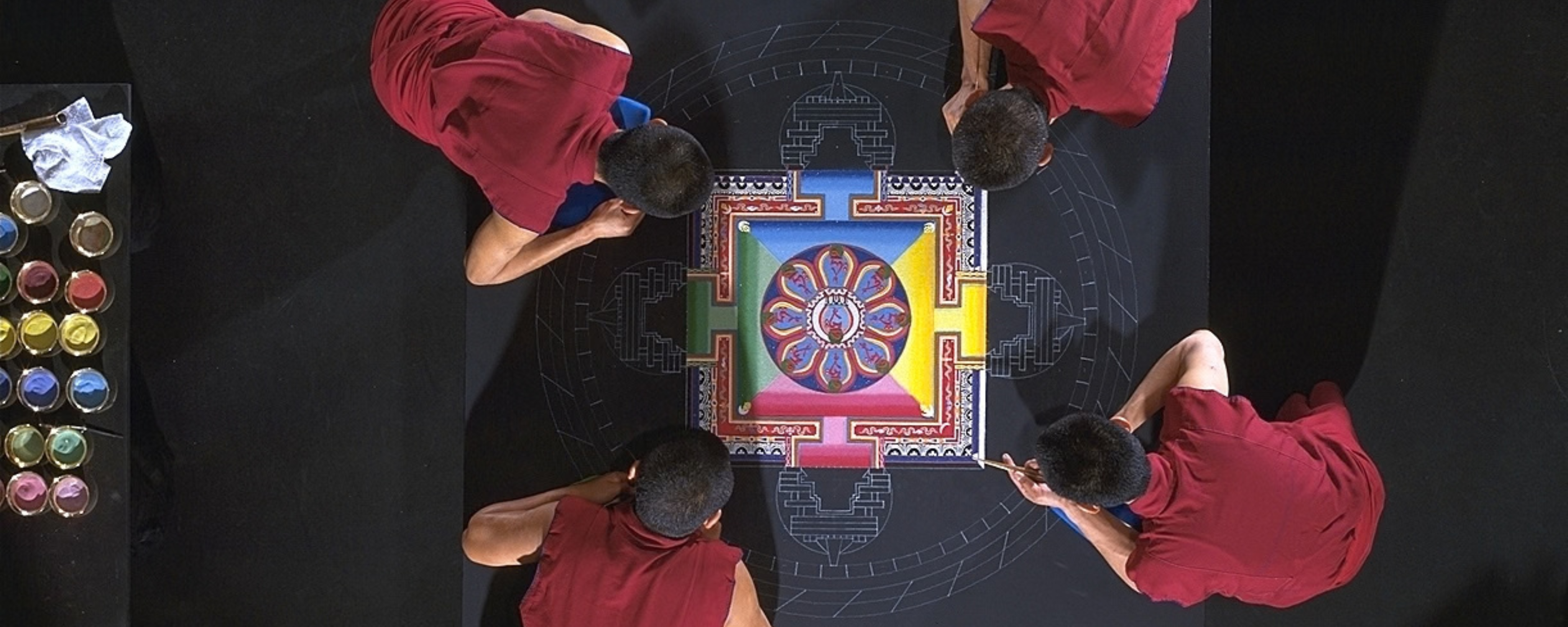
The process begins with an outline on a flat platform. Monks then use narrow metal funnels called *chak-purs* to place the colored sand. Rubbing a metal rod along the funnel’s ridged surface creates vibrations that allow the grains to flow in controlled streams. Millions of grains are arranged over days or sometimes weeks.
There is something fascinating about this combination of delicacy and discipline. Loose sand becomes a clear boundary, a curve, a field of color. Tiny movements contribute to a much larger whole.
For an observer, this can become an exercise in attention. Watch long enough, and the smallest changes become noticeable. Progress emerges through steady accumulation.
That offers a useful reflection for everyday life. A thoughtful response, a patient conversation, or a small act of generosity may seem insignificant on its own. Over time, such choices shape the character of our relationships.
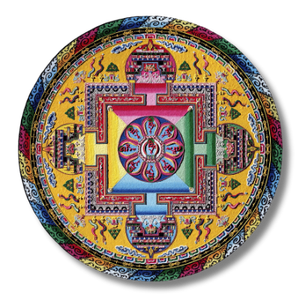 The Medicine Buddha: Compassion Directed Toward Suffering
Different mandalas express different spiritual intentions. The Medicine Buddha Sand Mandala centers on healing and the alleviation of suffering.
In Tibetan Buddhist tradition, the Medicine Buddha embodies enlightened healing qualities. The associated mandala represents the sacred residence of the Medicine Buddhas, whose compassionate aspirations concern illness, sorrow, confusion, and other forms of suffering. Its significance embraces both physical well-being and the healing of the mind.
This gives the practice a deeply human focus. Suffering is something we recognize across differences in language, culture, and belief. We know what it means to worry about someone’s health, carry grief, or wish we could ease another person’s pain.
For a viewer, the Medicine Buddha mandala can prompt a personal question: How might concern for others become something we practice, rather than something we only feel?
Why Sweep Away Something So Beautiful?
The dismantling may be the most challenging part to understand.
Traditionally, most sand mandalas are swept up shortly after completion. The act expresses impermanence: the reality that things arise, change, and pass away. Sand is then carried to water, where its release signifies the sharing of healing blessings with the wider world. Seen through that understanding, the ending completes the practice.
We often respond to change by trying to secure what we love. We want a meaningful season to continue, a relationship to stay familiar, or a moment of happiness to remain untouched.
The mandala offers another possibility: caring fully while acknowledging that we cannot make an experience permanent.
Its temporary nature does not diminish the skill devoted to it. Perhaps it makes that devotion more striking. The care was given freely, without requiring the result to last forever.
What Remains After the Pattern Disappears?
The finished design may vanish, but an encounter with it can remain in memory: the patience of the makers, the astonishing detail, the surprise of watching beauty take shape in such fragile material.
For those reflecting on the practice, its significance can extend into ordinary choices. We might listen more closely because a conversation will end. Appreciate a familiar place because it will change. Offer kindness without needing recognition or a lasting record.
A sand mandala brings us face to face with a difficult and liberating possibility: something can be temporary and still deserve our deepest care. As the grains are released, the invitation to live with greater attention and compassion remains.